In October we collaborate with RangeForce to cater you the best talks we got for you this month. This one is kindly hosted by RangeForce.
Agenda
Developers: To blame or not to blame? Margus Ernits CTO @ RangeForce
While the cyber threat landscape keeps constantly evolving, security become more crucial for companies. We read daily about new data breaches tied to an application security vulnerability. What is behind all these vulnerabilities? Why do they keep happening? Margus Ernits will talk about building a security culture that is able to keep pace with the threat landscape. You will learn how to (not) build a security culture in your development team.
Shit, I got promoted and I’m now a leader… So what now? Miguel Caron Head of Baltic Studios @ GameSys
This one is a crash course for those who just got promoted into leadership and are struggling finding their ways around the new challenges they’re now facing. Miguel will share his best insights on being a genuine leader that people love to work with.
Exploring GraphQL-Braid: Leaving RESTish world and building a distributed GraphQL system
Jonas Kiiver (VP of Technology @ Monese)
Do you have 100 microservices on your backend all exposing an API? And Android and iOS apps trying to communicate with them?
You would probably create a funnel-like API which forwards app calls, collects and returns the data. Then the app guys ask you to return one more field to the endpoint or create a new endpoint. A simple GET request (DB-wise). You plan, you build, you release. App engineers are waiting. Product guys are waiting. Users are waiting!
Then you wake up one day and see that you have an age-old endpoint which returns half of the database. You have to put an end to this mess! What options are there?
In this session we will share the result of our GraphQL and Atlassian Braid exploration journey. We are building a new distributed services architecture which will combine GraphQL backends into one schema. The result should be a fast, safe and easily maintainable cluster of microservices.
Burnout syndrome – why should you take it serious
Edgars Letinskis (DevClub.lv)
In this talk, I will share my experience with burnout syndrome – symptoms, how to avoid or cope with it and will use mega patented Chopstick method to explain why should you take it serious.
Being Reactive is the key to staying within the modern standards. We start with a simple MVC style application. First, we define a modern system. Then we introduce and solve the problems with the application. We will keep our REST API working the same way while utilizing Event Driven Architecture and many more!
Anton Arhipov Developer Advocate @ JetBrains
TeamCity build pipelines
TeamCity is a great tool for Continuous Integration with a lot of advanced features provided out-of-the-box. In this session, we will learn how TeamCity helps the software development in the daily routine; what was added to the product in the latest releases; what features are coming next.
It covers general problem of creating monitoring and observability without killing your Ops motivation team with False Positives and unexplained alerts.
Problems on this side, pitfalls, anti-patterns, and how to make it right.
How to manage a monitoring zoo. Spaghettification of dashboards. Why Uber needs 9 billion metrics (¯\_(ツ)_/¯) and why this is antipattern. Metrics as a stream of data. We talk about new Flux language from InfluxDb. A bit of time series analysis and defining of pipelines in Flux for metrics data. Drunkyard walk on your metrics or why to measure a randomness.
Andrei Solntsev Software developer @ Codeborne
Antistatic
What’s wrong with static methods (apart from them not being inline with OOP conventions)? Is dependency injection really that great? Is there life after Spring?
These question have been causing a lot of flame for a long time now. Butts hurt bad, but the community haven’t reached the consensus yet. I will share how my own understanding of these things changed over time and where did I end up eventually.
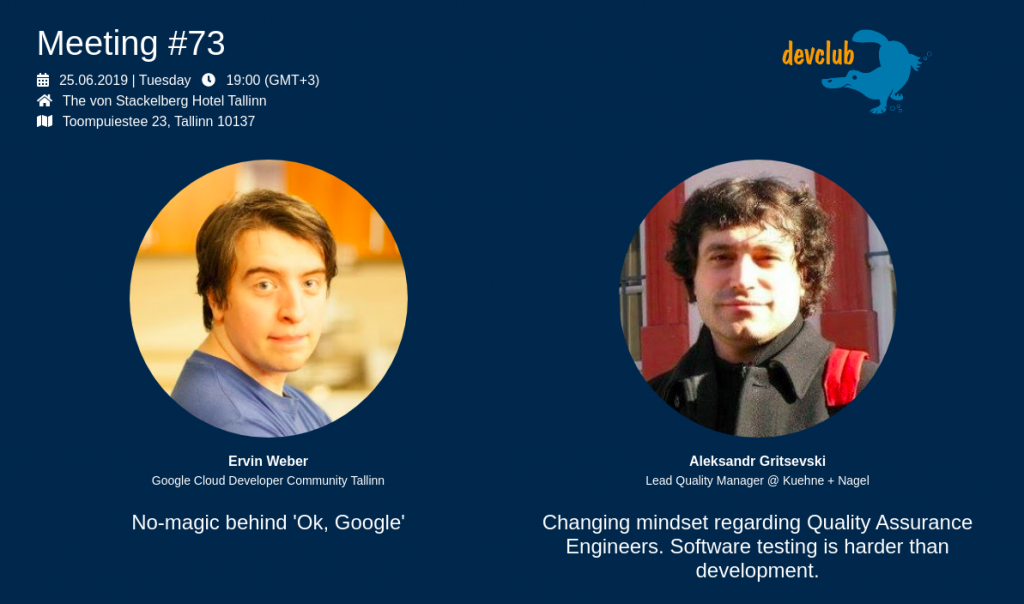
For June meeting we’re gathering at Von Stackelberg hotel and having two Devclub’s very own speakers presenting for us.
No-magic behind ‘Ok, Google’
Ervin Weber from Google Cloud Developer Community Tallinn
The talk is about Ervin’s experiments with Google Assistant devices. Where it feels natural and where it comes short. Why as developer you should consider this platform for your products, and of course, some “hello world” demo.
Changing mindset regarding Quality Assurance Engineers. Software testing is harder than development.
Aleksandr Gritsevski
Two decades ago when modern technologies were emerging, the idea that software should be tested before getting released was meaning only that someone has to act as a future user of the software what led to the concept of Manual Testing.
However, this was taking too much time, especially at the time when number of functions included in software were increasing so rapidly. This is why companies discovered that some actions which were being repeated for a number of times could be automated what was the basis for Automation Testing.
Although, this is a much faster process than Manual Testing, this is not enough to satisfy the needs of the company, because the way it is done is usually based on simulating logical actions which can be done by the future user. This means that work of the QA team members is limited to creating simple auto tests and doing some manual testing where it takes less effort than creating an auto test.
At the same time, having this idea HR officers are hiring people who are unable to bring QA forward in order to achieve better quality of the product. Ideally, the person who is the one responsible for quality should be involved in the process of development and not just having to assess what has been already done as well as to be able not only to test the product, but to be able to understand why the mistake has occurred what is possible only in case if QA specialist has sufficient programming background.
The speaker will tell how to change the mindset regarding Quality Assurance Engineers based on his own experience in the field as well as is about to give some pieces of advice that will help both the ones responsible for hiring QA specialists to recruit the most competent people and the ones pursuing careers in the industry to know what is expected from them.
We’re happy to team up with Topia again for another big one! This time we’ve got three speakers for you touching wide range of topics from business-focused to deep technical to very social.
Agenda
Dividing up Metropolises Modelling Rent prices across the globe Mervi Sepp (Topia)
Reactive and functional approaches Aleksandr Tavgen (Playtech)
Toll of personal privacy in 2018 Kirils Solovjovs (Possible Security, LV)
Hello! We’re very excited about the guests for this one! Doug comes to share his Google Developer Expert knowledge and Lauri will give software engineers an introduction to the world of data engineering.
Agenda
Fast and Beautiful Images
Doug Sillars Web Google Developer Expert, author of O’Reilly’s “High Performance Android Apps”.
“Fast and Beautiful Images” – the best ways to build images for all of the screens/devices that are out there.
Differences between software (engineering) and data engineering
Lauri Koobas Data Warehouse Engineer, Starship Technologies
A brief introduction to what it takes an experienced software engineer to enter the data engineering world.
This time we’re excited to collaborate with Starship for the first time. The event is held at Starship office, Teaduspargi 8, 12618, Tallinn
Agenda
18:30 Starship intro and Office tour
19:00 Achieving low latency communication between services and robots (Pavel Varyukhichev) How we brought a solution of handling robots online from several robots to thousands of robots? The future is here.
19.35 Short break
19:45 Robot scheduling challenges compare to taxi orchestration (Jaanus Soots and Vitalii Lakusta) Is delivery robot logistics easy as package courier milk-run or complicated as taxi orchestration? What we are facing now, how that is solved and what will wait for us ahead?
20:20 Networking time
20:40 Consumer Driven Contract Testing (Indrek Ots) Consumer driven contract testing is a method of verifying that services (e.g. API consumer and an API provider) speak the same language. By providing examples, API consumers set expectations on providers on how they should behave on specific inputs.A set of expectations forms a contract that’s produced by consumers and is shared with providers.Contract obligations are verified by providers with tests that can be run in isolation, without having to set up integration testing environments. That lets them evolve independently and get immediate feedback when they’ve broken any of their API consumers.Contract testing can be used anywhere where you have two services that need to communicate with each other but becomes especially useful in environments with many services (e.g. microservice architecture).
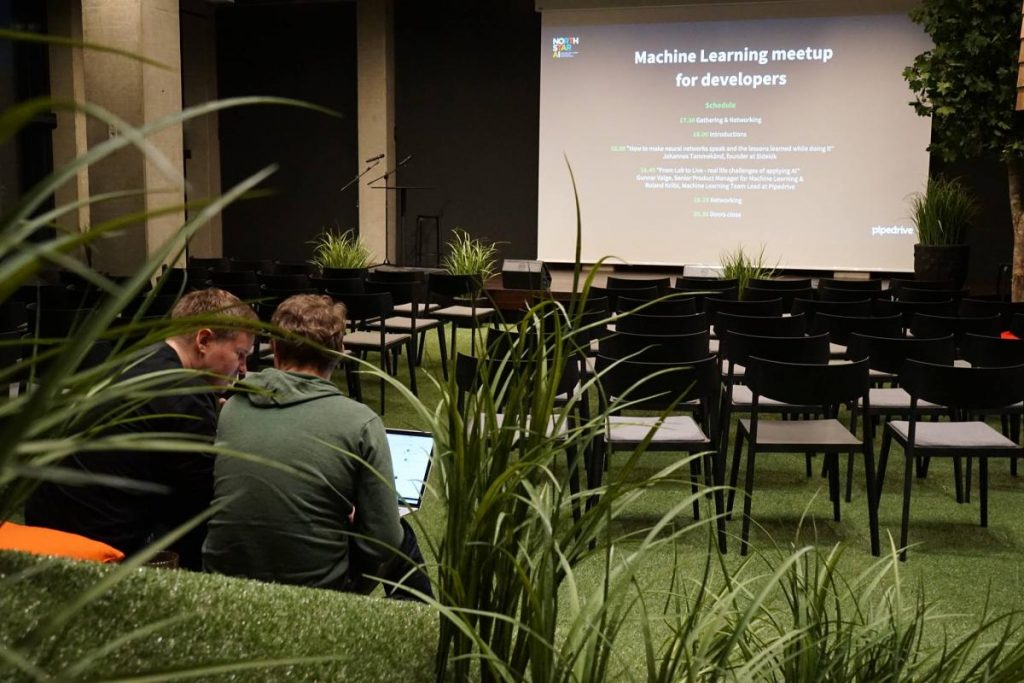
This time we’re excited to join forces with Pipedrive to talk about projects and organization.
Here’s what the plan looks like:
18:00 – Gathering & Networking 18:25 – Introductions 18:30 – “Project clarity – Random rant from an old engineer” by Nikita Salnikov-Tarnovski (CTO, Plumbr) 19.30 – Break 19:45 – “What is Tribes & Missions and how did Pipedrive get there?” by Martti Kuldma (Head of Software Development, Pipedrive) 20:05 – “How do you align the Product organization around a highly agile team setup such as Tribes & Missions?” by Vinay Ramani (Chief Product Officer, Pipedrive) 21:00 – Networking 21:45 – Doors close
See you there!
How to get there:
The event takes place on the 2nd floor (enter via the main entrance and the office admin at the front desk will guide you to the 2nd floor).
Parking: Limited free parking spaces in front of the building. If these are full, please use the free parking spaces that are reserved for Pipedrive cars in the parking house (spaces: A184 – A321) or the paid parking area next to Telia building.
At Pipedrive we have a strict socks or slippers only policy – you can wear your favorite socks or you are welcome to use our guest slippers 🙂
This one is organized together with Pipedrive, a leading sales CRM platform that makes over 80,000 businesses unstoppable. Pipedrive keeps things moving, stops tasks falling through the cracks and kills the tedium of admin. Pipedrive ensures that sales activities remain targeted, ambitious and realistic. Today, over 80,000 customers in 170 countries, and across 100+ industries leverage Pipedrives’ award-winning software to manage their sales process. https://www.pipedrive.com/
We’re kicking off 2019 with some good talks at our traditional place.
Agenda
IntelliJ IDEA Tips & Tricks
Anton Arhipov
This session takes you through the cool features of IntelliJ IDEA, uncovering not so commonly used features. We will review how to utilize the power of automated refactorings, shortcuts, fast navigation, and other features that the IDE provides for better productivity.
Technical who?
Valeri Tverdohleb
I will try to answer a quite uncertain and not an easy question – What does techical artist do? – based on game development at Gamesys. During this session we’ll build a prototype and define its necessity.