It covers general problem of creating monitoring and observability without killing your Ops motivation team with False Positives and unexplained alerts.
Problems on this side, pitfalls, anti-patterns, and how to make it right.
How to manage a monitoring zoo. Spaghettification of dashboards. Why Uber needs 9 billion metrics (¯\_(ツ)_/¯) and why this is antipattern. Metrics as a stream of data. We talk about new Flux language from InfluxDb. A bit of time series analysis and defining of pipelines in Flux for metrics data. Drunkyard walk on your metrics or why to measure a randomness.
Andrei Solntsev Software developer @ Codeborne
Antistatic
What’s wrong with static methods (apart from them not being inline with OOP conventions)? Is dependency injection really that great? Is there life after Spring?
These question have been causing a lot of flame for a long time now. Butts hurt bad, but the community haven’t reached the consensus yet. I will share how my own understanding of these things changed over time and where did I end up eventually.
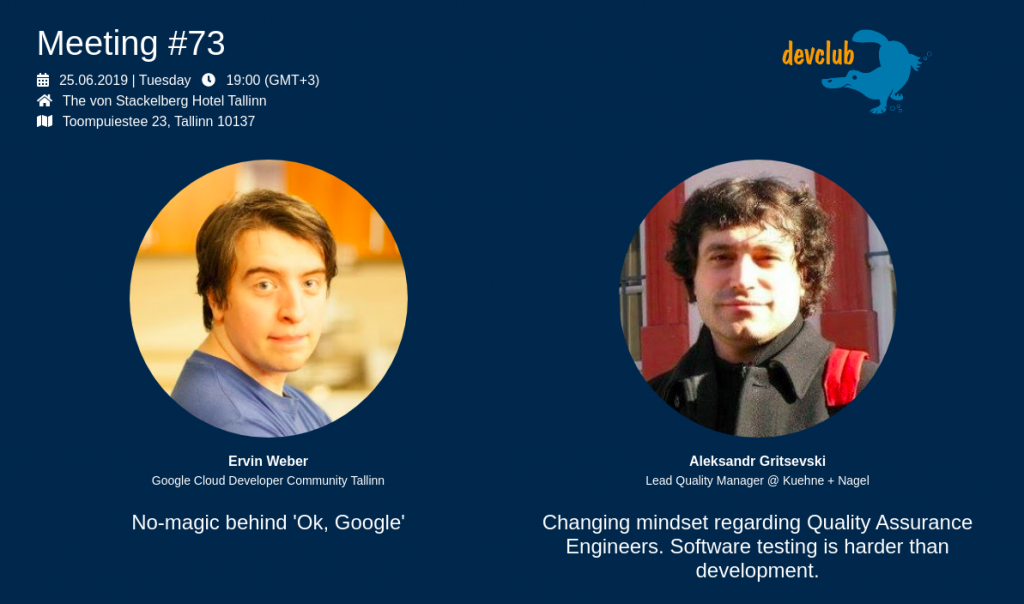
For June meeting we’re gathering at Von Stackelberg hotel and having two Devclub’s very own speakers presenting for us.
No-magic behind ‘Ok, Google’
Ervin Weber from Google Cloud Developer Community Tallinn
The talk is about Ervin’s experiments with Google Assistant devices. Where it feels natural and where it comes short. Why as developer you should consider this platform for your products, and of course, some “hello world” demo.
Changing mindset regarding Quality Assurance Engineers. Software testing is harder than development.
Aleksandr Gritsevski
Two decades ago when modern technologies were emerging, the idea that software should be tested before getting released was meaning only that someone has to act as a future user of the software what led to the concept of Manual Testing.
However, this was taking too much time, especially at the time when number of functions included in software were increasing so rapidly. This is why companies discovered that some actions which were being repeated for a number of times could be automated what was the basis for Automation Testing.
Although, this is a much faster process than Manual Testing, this is not enough to satisfy the needs of the company, because the way it is done is usually based on simulating logical actions which can be done by the future user. This means that work of the QA team members is limited to creating simple auto tests and doing some manual testing where it takes less effort than creating an auto test.
At the same time, having this idea HR officers are hiring people who are unable to bring QA forward in order to achieve better quality of the product. Ideally, the person who is the one responsible for quality should be involved in the process of development and not just having to assess what has been already done as well as to be able not only to test the product, but to be able to understand why the mistake has occurred what is possible only in case if QA specialist has sufficient programming background.
The speaker will tell how to change the mindset regarding Quality Assurance Engineers based on his own experience in the field as well as is about to give some pieces of advice that will help both the ones responsible for hiring QA specialists to recruit the most competent people and the ones pursuing careers in the industry to know what is expected from them.
We’re happy to team up with Topia again for another big one! This time we’ve got three speakers for you touching wide range of topics from business-focused to deep technical to very social.
Agenda
Dividing up Metropolises Modelling Rent prices across the globe Mervi Sepp (Topia)
Reactive and functional approaches Aleksandr Tavgen (Playtech)
Toll of personal privacy in 2018 Kirils Solovjovs (Possible Security, LV)